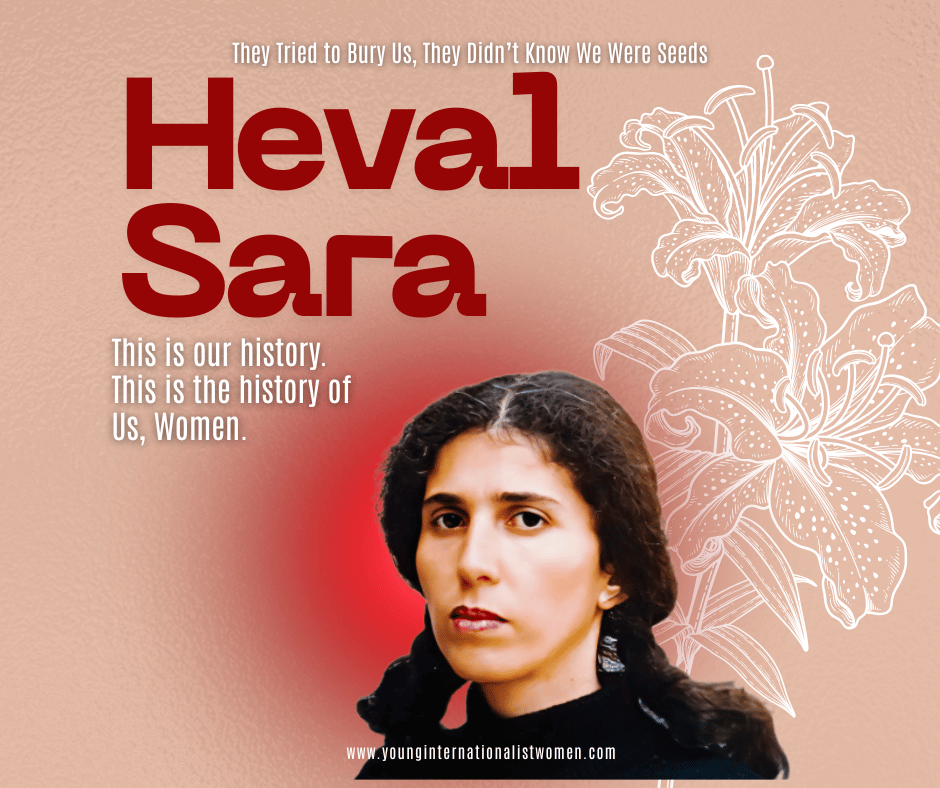
Thirteen years ago, on 9 January 2013, the world stopped in Paris. Sakine Cansiz (known as heval Sara) was assassinated. She and her comrades Fidan Doğan (Rojbin) and Leyla Şaylemez (Ronahi) fell as martyrs following an attack — because they were women, because they were revolutionaries, because they were bearers of values, because they were free, beautiful and fighting.
These were three political femicides, but despite overwhelming evidence, the defendants were not brought to trial.
On 23 December 2022, three years ago, in the same way, at the same time, again in the French capital, Emine Kara (known as heval Evîn, one of the leaders of the Kurdish women’s movement) and two other comrades, Mir Perwer and Abdurrahman Kizil, were martyred.
After 10 years, this was a clear signal from the enemies of the movement to break hope and silence the struggle for a free society, with the vanguardship of women.
Sakine represents the resistance of her people: faced with the denial of their existence, language, culture and life, she imagines the resurrection of society. And she begins to ask herself, ‘Where to start, how to achieve freedom?’
Heval Sara’s whole life has been a struggle, as she herself writes in her autobiography.
She was born in 1958 in Dersim in winter, into a Kurdish Alevi family. In Dersim, before her birth, the Turkish state killed, massacred and displaced thousands of Kurds who rebelled against assimilation, so much so that the rivers were stained red with blood.
As a young woman, she understood what it meant to be a woman in her social reality: she chose to break with the system and not to adapt to compromise. She chose to create life, to be revolutionary.
Her search for a just existence never stopped. First she joined Turkish socialist left-wing groups, then she met the Apoist movement. She began organising in the 1970s, under difficult conditions, in secret, against the ferocity of the Turkish state and against the prejudices of the time, which saw women as destined to be mothers and wives.
Present since the first congress of the Kurdistan Workers’ Party on 27 November 1978 in the village of Fis, in Amed, she was one of the first female comrades and paved the way for millions of others.
Her courage gave rise to the movement of free Kurdish women.
Her soul is wise. Her determination, her humanity and her questions have inspired and continue to inspire.
Sakine was arrested in May 1979, along with many other comrades. Despite being tortured, she did not once say a single word to the enemy. During her 11 years in prison, faced with atrocious physical and psychological attacks, severe torture, oppression and betrayal, she resisted with her head held high.
One day, the highest-ranking prison official asked her:
‘What is your name?’
‘Sakine.’
‘Are you Turkish or Kurdish?’
‘I am Kurdish.’
He slapped her and asked again: ‘Are you Turkish or Kurdish?’
Sakine replied: ‘I am above all a revolutionary. In the revolution, origin is not so important, but I am Kurdish. If I were Turkish, I would certainly admit it.’
This was the fighting spirit she propagated.
She organised all the women in the women’s sections around her, led hunger strikes, and spread hope and ideas to those around her.
She always tried to find solutions to problems. The slogan she carried with her, ‘Surrender leads to betrayal, resistance leads to victory,’ showed that the only possible way to confront fascism was through rebellion and organisation.
After years of imprisonment, she travelled to Damascus, Syria, to attend the academies of Reber Apo (Abdullah Ocalan). She was really surprised when she saw her picture in Reber Apo’s room: this was an expression of Reber Apo’s respect towards her struggle and determination.
She then spent several years in the mountains. Here she travelled from mountain to mountain, climbing peaks and crossing rivers. She became a strong and tireless guerrilla fighter, who never stopped thinking, questioning, committing herself and taking responsibility.
In her own words: “Strength is often misjudged. For example, strength means to start something new in life, to create something from nothing and make life more beautiful. Strength means to write poetry in the mountains. Strength means seeing and hearing the water. Even living with the beauty of nature is strength.”
For her, life, struggle, and love are inseparable from one another; in fact, she states, ‘I wanted to love in the struggle. I wanted to love as I fought.’
A life other than a revolutionary one was unthinkable for her. The struggle she fought was for the liberation of women. And as she herself states: ‘Liberation knows no borders but means a constant search, a continuous aspiration to beauty.’
Heval Sara sowed the first seeds, now it is up to us to continue sowing and reaping the fruits. What does Sara teach us? Which aspects of her personality can inspire us? How can we embody her beauty?
These questions, especially today, can accompany us and lead us to reflect.
During the attack in Paris, the goal was to kill courageous women who were fighting for freedom. But the spirit of these three women will never fade. Martyrs never die.
We can follow in their steps through our daily actions aimed at the building of a just and communal life.
Sara Rojbin Ronahi
Jin jiyan azadi.
Woman, life, freedom
Leave a Reply