Author: Young Internationalist Women

  • The truest comrade of nature: Şehîd Elefteria Hambî

    The truest comrade of nature: Şehîd Elefteria Hambî

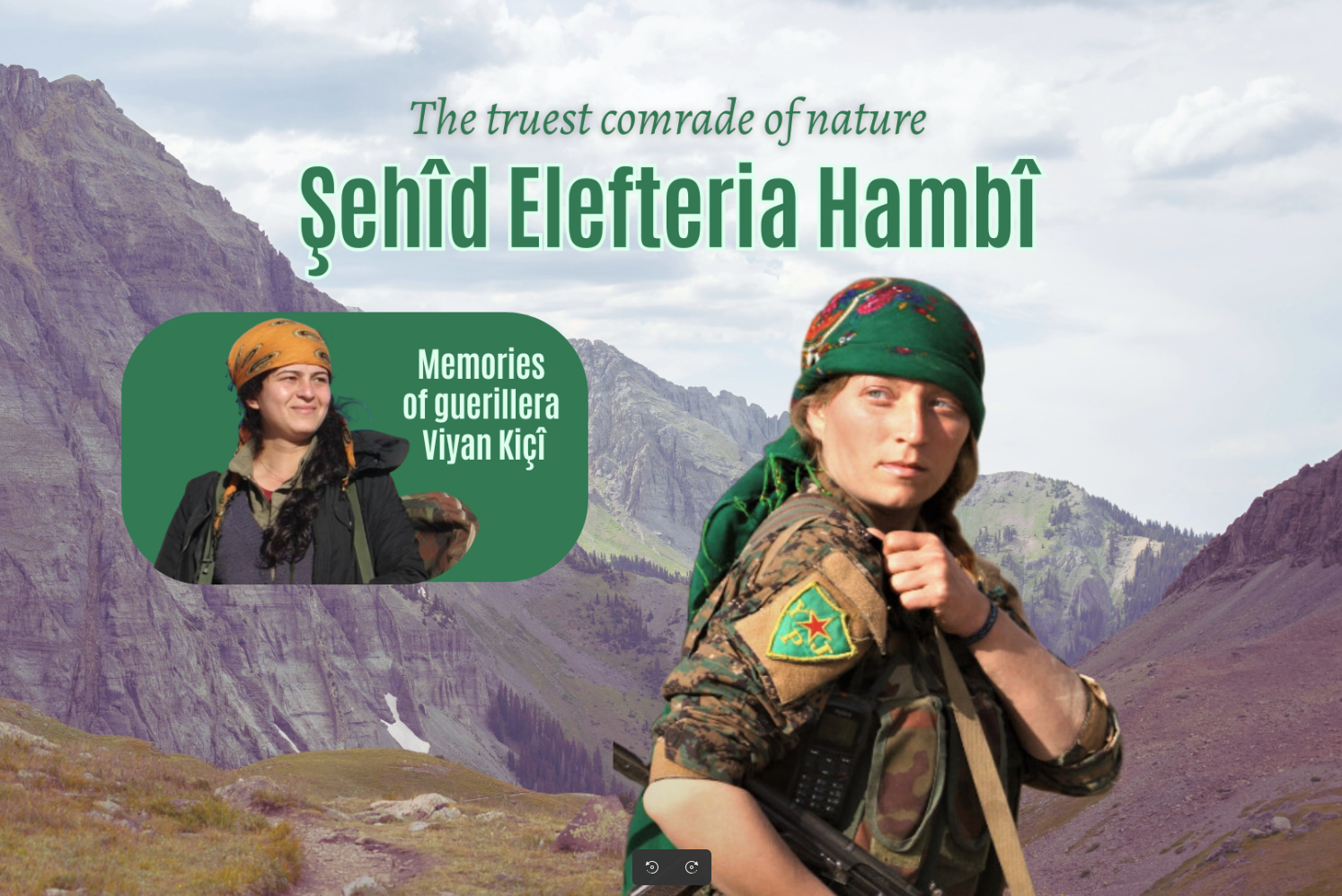
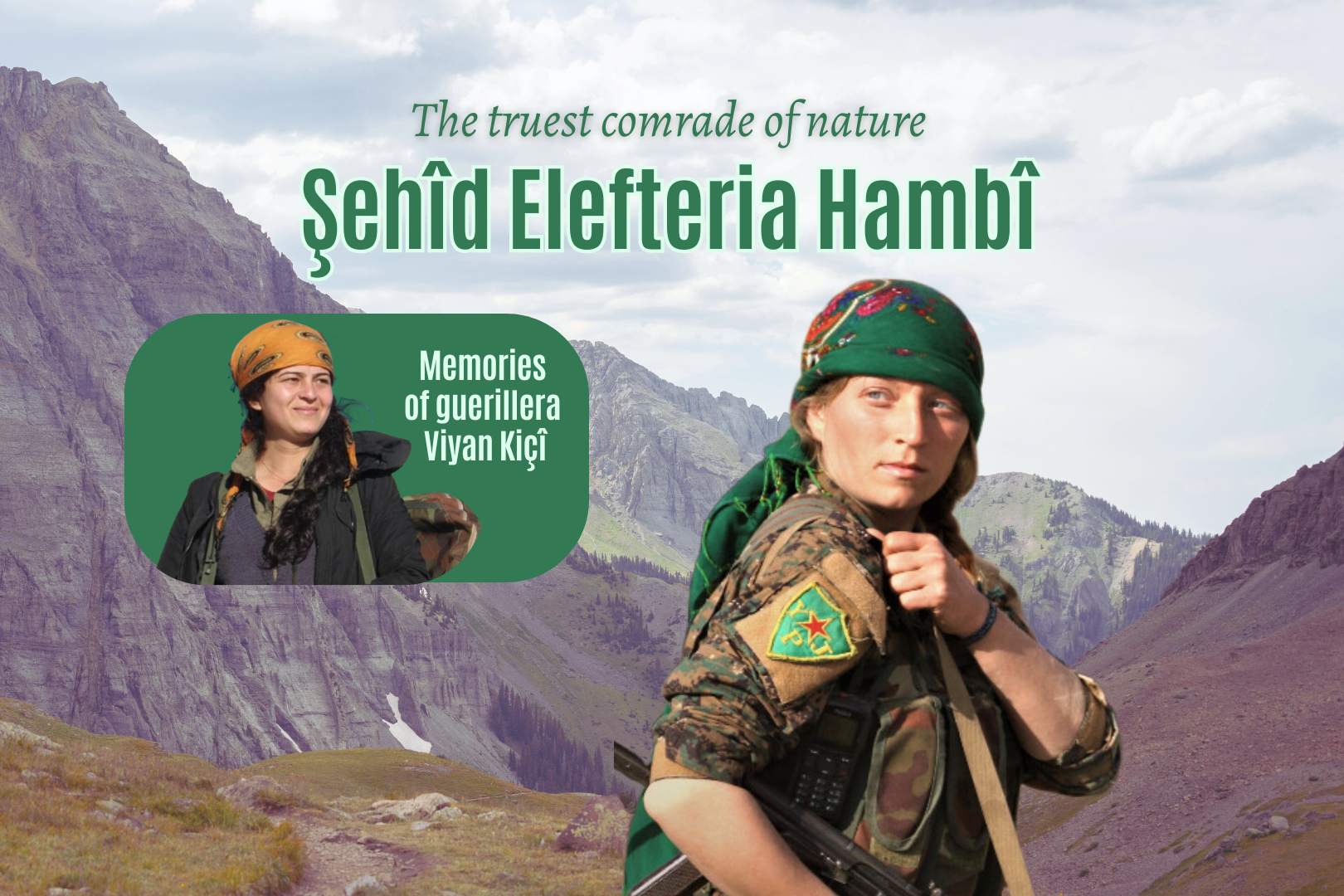
    25th of November is the International Day for the Elimination of Violence Against Women. Meanwhile, it is the sixth anniversary of the martyrdom of Şehîd Elefteria Hambî. To commemorate this significant day, we present an interview with comrade Viyan Kiçî, who shared a close bond with Şehîd Elefteria in the free mountains of Kurdistan. Through Şehîd Elefteria, we honour all the revolutionary women who sacrificed their lives for freedom and a better world.
    My name is Viyan Kiçî. When I met Heval Elefteria first, I was in Garê, Sêdarê (Southern-Kurdistan), in a mixed unit. Life as a guerrilla in the unit is well known: it mostly consists of practical tasks such as building caves, acting as a courier, taking shifts on hilltops, capturing new hilltops and organizing logistics. At that time, there were more than 20 comrades in our group. It was in Garê Sêdarê that I met Heval Elefteria, who came to us for her new tasks. What touched me most when the comrade came to us were her eyes. They were a deep shade of blue. She also had a beautiful smile. When she reached the mountains, she was full of curiosity, love, morals and joy. She not only caught my attention, but she also caught the attention of all her comrades around her, especially with her broad smile. When she arrived, they greeted her and immediately set about preparing tea and food. But it was as if Heval Elefteria had already lived with us for years; she prepared the water for the tea herself. She integrated herself into our lives very quickly, adapting with ease. At first, she observed her comrades closely and got to know them all better, but she quickly won a place in their hearts. With her sparkling eyes and smile, she brought them joy. We lived together in the unit. The number of male comrades and women comrades constantly changed, but there were always more of us women. We carried out practical work without any break, day and night. There was always a drone above our location and our possibilities were drastically reduced; guerrilla life had changed. We had to adapt to these changes. It was necessary to try our hardest, day and night.

    Heval Elefteria came from Germany with experience when she reached her first place in the mountains. During our daily lives together, she would talk to us and share things, especially stories about her life in the forest. She had always lived in the forest, fighting against state violence that threatened the ecology of her homeland. She was a rebel and had always acted radically in this regard. This is why she left the city; her life had been in the forest ever since, and she was one with nature — she knew every plant. She saw everything that passed before her in a very special way: her interactions with the plants and her love for animals. When she saw an animal, she would look at it, but her approach was truly unique. Heval Elefteria had reached a point where she felt connected to nature. For these reasons, she experienced few difficulties in guerrilla life. Her beautiful connection with nature was a part of her, and there were many examples of this. One day, instead of watching out, Elefteria was collecting and eating various plants — she loved nature so much. If we accidentally cut a plant, she would become very angry because she could not bear it and always defended nature. Her feelings for nature were very intense.

    After spending some time in the mountains, her stance as a guerrilla became more and more clear: her comradeship, her interactions, her love, her connection with the ideas of Rêber Apo (Abdullah Öcalan, the ideological leader of the Kurdistan freedom movement) and her identity as a woman. Day by day, she grew stronger. When she joined the unit, she did not encounter many difficulties, but of course, all comrades are confronted with challenges, whether they want it or not. Above all, when it comes to exchange, attitudes and life in general, if you want to learn, you have to put in a lot of effort. But each day that Heval Elefteria moved on, her eyes were shining brighter. Her conversations and her comradeship became more profound. The comrades gathered around her as she created a sense of communal life and developed her language until she could fully express herself. She read a lot of Rêber Apo’s writings and discussed it with the comrades. She shared the problems she experienced. She was able to share everything she felt. Because of this, she adapted very quickly and found her place in the hearts of her comrades. She shaped her personality, and I would say that she set an example for the unit by coming from Germany to resist in the mountains of Kurdistan. She had traveled thousands of kilometers to reach Rojava, participated in the revolution and witnessed it with her own eyes. It had a profound influence on her. As a woman, she always pursued her chosen goal. Kurdish, Arab and women from many different nations in Rojava fought together against ISIS and shaped the revolution. Heval Elefteria was deeply impressed by these women and moved by the revolution. She continued to resist until she reached the mountains.

    When she came to the mountains, she could understand them. She felt at one with nature and had a very natural energy. When you think of Heval Elefteria, nature immediately comes to mind. In fact, it got to the point where we used to joke about her not choosing the name ‘Xweza’ (nature). Through the influence of the revolution and the mountains, she found her place in the world. She would often say, “I wish I had come much earlier.” Of course, she also experienced difficulties, but she shared everything. Of course, it is not easy to travel thousands of kilometers, cross the Middle East and reach places of constant war— a lake of blood, a place of constant killing and genocide. To come to a place known as such. Whether you like it or not, there are many negative perceptions of the region from the outside. But Kurdistan is also a place of culture and art, and people there have always played an important role in struggles and resistance. She had taken part in actions and uprisings before. When she arrived in the mountains, she did so with an open mind. She confronted her fears and pain head on; she never saw them as obstacles. Her thoughts, particularly with regard to ecological movements, were beautiful and profound. She wrote about these things several times and shared them with us. Over time, she wanted to take different steps to organize things, to spread the ideas of Rêber Apo and to grow the women’s freedom movement. She always had goals for the future. During our discussions and conversations, we shared our views with her. What I can particularly say about her personality is that she was always a loving comrade. Heval Elefteria was very clear-minded — she never wavered between the right and the left path, nor between acting and not acting. She was very confident of herself and determined. If she did not accept something, not even a thousand comrades could convince her. Even when negative outcomes occurred, her strong personality shone through.

    She could carry heavy burdens. For example, when we were going through very difficult times and there were four or five drones constantly circling our area, Heval Elefteria went to support the comrades responsible for logistics. Due to the drones, they had to carry out most of their work at night. She volunteered to take on these tasks. I actually wanted her to stay in the caves — maybe it would be too difficult for her outside; maybe she would feel better inside. As a comrade who came from Europe, we needed to be especially careful to protect her. We wanted to look after her. At first, we brought her into the cave, but after a few days, she couldn’t take it anymore. She said, ‘Heval, I want to go and carry the logistics. I want to learn how to work underneath the drone. I can carry this weight. I know I can fight the enemy.” For her, working outside and moving under the drone all the way to the tunnel was an adventure. She insisted on joining this group. It didn’t matter what we did or didn’t do — she was determined. She had to learn to deal with her difficulties and the weight. She wasn’t used to it. Until then, she had never carried such heavy loads over such long distances. She told us that she also had to organize logistics in the forest sometimes. But in the PKK movement, where the enemy poses a very serious and constant danger and defense is necessary from all sides, everything is connected and requires effort. Heval Elefteria was not completely unfamiliar with it. Even though she had no experience in many areas, it was not a problem for her. That is why she wanted to develop herself through effort — her life began with effort. Effort makes you strong and allows you to grow; it is through effort that you learn. It was through her initiative that she joined the logistics work.

    She truly took on a vanguard role. While the comrades were on the move from morning until night, she stayed awake the entire time. She took no breaks until the work was finished. She worked all day. Even when the conditions prevented the completion of the logistics — when all the comrades were tired, hadn’t eaten or were not feeling good — she continued the work. Heval Elefteria was a remarkable vanguard in this field, too. She always wanted to learn more. Sometimes, when you saw her looking at a stone, you could tell that she was seeing it in a completely different way and giving it a whole new meaning. For her, everything was alive. Heval Elefteria became a role model for all her comrades. During our meetings, her name was mentioned many times as an example. She fought too, naturally taking on the role of a vanguard. She advanced quickly, supporting the comrades and taking over their tasks if necessary. She was determined to foster a spirit of comradeship, and the other comrades recognized this. This created a deep connection between us.

    Another notable aspect of her character was her deep connection to plants and herbs—she had a particular love for nettles. When you touch this plant, it stings and burns. Usually, it’s not something you can easily take, though sometimes comrades use it as medicine. Heval Elefteria collected these plants around our area every day. Whenever I went looking for her, she was gathering nettles like a nomad. Nomads are known for their connection to nature, their hard work, and their sweat. Her face always turned red quickly. Her life and love were universal. We always called Heval Elefteria “Keça Koçera”—which means “nomadic girl”—and she was happy about it. Plants, flowers, water, and fruit abound in Sêdarê, which is known for its fruits and cold waters. It is like a paradise. Heval Elefteria always said that she was lucky the comrades sent her to this region. “Maybe they knew that I love nature so much.” I would therefore call her the truest comrade of nature.

    We can also mention her combative personality. We took over some new mountaintops. Before, our comrades placed themselves on these mountaintops, but then they were left empty for a while. As the war progressed, we decided to place ourselves on these mountaintops for preparation. Peaks such as Barût and Polat were to be taken. When we planned to place ourselves on Barût, we assembled a team. We decided to send Heval Elefteria as well so she could learn and gain experience. She already knew how to react to drones, how to move, especially alone, and how to change her position and meet comrades. She had moved with a courier from one place to another many times. She had reached the level where she could adapt to guerrilla life. We discussed with the comrades who to send, and everyone agreed that we should send her. We knew that if we didn’t, she wouldn’t accept it and would rebel. At all the meetings, she would have asked, “Why wasn’t I sent?” So, it was good for both the comrades and her. She put in a great deal of effort and spent a long time working. Heval Elefteria loved nature very much. The peak was very high, and the atmosphere there changed greatly for her. Shortly before she left, she was very serious, with her weapon freshly cleaned and her ammunition and other necessities prepared. The comrades prepared so thoroughly that they were ready for a war situation. The atmosphere was truly like a state of emergency. With her preparations, she was ready for an operation. She filled this role well, carrying her bag, weapon, and ammunition belt.

    Given all the joy and love she gave us, it was impossible not to be touched by it. We knew that she would fly out of happiness when she reached the mountain peak. With the sounds of “tîlîlî” (shouts of joy), clapping, and slogans, the comrades set off. The peak was not far away—maybe half an hour to forty minutes. The comrades stayed on the peak. I often visited them. Sometimes they came down for education sessions, classes and meetings. After Heval Elefteria went to the peak, she changed even more. It became impossible to get her away from the mountaintop because she loved it so much. Once, when I went to visit the comrades, I looked for Heval Elefteria and found her surveying defensive positions. We had used these peaks before, so ammunition and supplies were still hidden everywhere. Wherever comrades had once been, you could still find things they had left behind.

    Heval Elefteria wanted to get to know the area, so she wandered around to explore it. She had a good understanding of military strategy. She once said to Heval Viyan, “When attacks happen, this will be our defensive position.” This made me very happy. A person, especially a guerrilla, must choose a place for self-defense before going to fight somewhere. The essential area must be chosen based on its defensive capabilities. Heval Elefteria understood this, and I was pleased. Having a comrade realize things this way in such a short time is a reason for joy. Heval Elefteria was full of love for the peak. No matter what we did or didn’t do, she stayed there. In the end, I went to the peak myself to bring her down with difficulty so that she could support the comrades in the cave with their tasks. Afterwards, I’m not completely sure, but I think she wanted to return to the peak. Instead, however, we brought her into the caves, where she stayed for a while.

    In general, after some time, the comrades are changing their tasks. For example, consider the mental effort required to build caves and tunnels. The comrades built all of the tunnels themselves, and they were all young. They worked with mines, hammer drills, shovels, and pickaxes. Some prepared the clay and some used wheelbarrows. Heval Elefteria contributed greatly to building the tunnels with the comrades and shaping communal life. She devoted all her energy and intelligence to it. She wanted to understand and saw that guerrilla life was very difficult, but it was her calling. She was moved by it and wanted to learn everything she could. She always asked questions, participated in discussions, shared her opinions, and offered suggestions. She was open-minded and flexible, not dogmatic. She was only sometimes stubborn, which may have been influenced by German culture. But we saw it as a positive trait.

    Yet, if she was not convinced about something, it was difficult to change her mind. She was a fighter and a rebel. She could endure great effort. Her martyrdom was extremely hard on us. The organization had high hopes for Heval Elefteria and always kept up with her progress. All the comrades asked about her and sent greetings. Everyone who met her remembered her; she had found a place in their hearts. Through her efforts, she developed deep bonds with the comrades. That is why her martyrdom was so difficult for us—for the organization, her family, and all the comrades who knew her. However, for us, there is no difference between comrades who give their lives for this revolution and this philosophy, whether they are Kurdish or from other nations, or from the Middle East or Europe. We live a life centered on ideas that bring us together from all over the world. We proudly follow in the footsteps of Şehîd Elefteria, and we still talk about her today. No matter how much I try to share, I cannot say enough about Heval Elefteria’s great love. Her perception, understanding, and expression were very special. Through her efforts, attitude, belief in change, and practice, she proved herself in this revolution. That is what I can share about Şehîd Elefteria.

    To all comrades who wish to follow in her footsteps, I would like to say that she is still alive for us. She was a person who left her homeland, crossed rivers and seas, and fought for other oppressed societies. She came to the mountains, a place where thousands of comrades resisted and were martyred. It takes a strong and self-sacrificing stance to struggle in these places. This comrade undertook such a long journey to fight oppression and achieve freedom. To me, this is the most meaningful stance in the world. We say that all martyrs are our light. Heval Elefteria is one of them. It is important for all comrades who knew her—in Germany or elsewhere—to learn about her attitude during the Rojava revolution and her struggle in the mountains. They must learn about her will, conviction, and belief in order to carry on her legacy. I see this as a very important point.

    Heval Elefteria is an example for all of us—not only for Kurdish women, but also for German women and women around the world. She was a pioneer for us all. She was a truly beautiful woman. When you looked at her and saw her smile, you could see her inner and outer beauty. As beautiful as she was on the outside, her thoughts were equally beautiful on the inside. Her thoughts and soul were one. This is what I can share with you. Of course, we have some shared memories, but many years have passed. The more you talk about them, the more vivid they become. I can now share these memories with you.
  • us, women – Ulrike Meinhof

    us, women – Ulrike Meinhof

    Jumping into the Unknown

    West Berlin, May 14, 1970, 9:45 a.m. Ulrike Meinhof is sitting in the reading room of the German Central Institute for German Issues. The political prisoner Andreas Baader enters, handcuffed and accompanied by two guards. For 75 minutes, he will speak about a book project with journalist Ulrike Meinhof. They read magazines and take notes. At around 11 am, three armed comrades storm the institute shouting «Hands up or we`ll shoot». Shots are fired from both sides. Andreas Baader and Ulrike Meinhof and everybody else who took part in the action jump out of a window at 1,5 m height and run to an Alfa Romeo waiting at the corner. The Red Army Fraction is born. Decades later, we will find out that Ulrike Meinhof jumped spontaneously. She was supposed to stay behind and report on the action later, without having to go underground herself.

    What drives a successful journalist and mother to abandon her entire life in an instant?

    Or maybe: what could have kept her from jumping? There was no other option. Where would she even have returned to? She had filled pages with relentless critiques on imperialist war-mongering, the half-hearted confrontation with Germany’s genocidal past and the twofold exploitation of the woman as a worker and a mother. And yet she remained part of it; still an isolated mother, still an exploited worker, still part of the murderous system.

    There was no other way, what she had endured until now became unbearable. She saw cops shooting, she saw her friends jumping.

    In this moment, with this jump, she gave a promise to herself; a promise she could not have broken easily without betraying her values. And even though she certainly could not have known what expected her, she dared to jump into the unkown. She woke herself up to stay alive. This one jump forward was not just about leaving something behind. May 14, 1970 was not only the day Andreas Baader was freed, not only the birth of RAF. This jump was cutting with the system to open everyone’s eyes.

    Lets jump back. West Germany, October 7, 1934. Ulrike Meinhof is born in Oldenburg. She was a child during the first world war. Through her texts we see how deeply she disapproved the war Germany had waged and the fact that life just continued while Nazis were still doing the same jobs, only in different clothes.

    She grew up during the Second World War and lived her youth in the post-war period. The whole German nation was crushed about having lost:Both about having lost the war and about having lost so much of its humanity that a fascist extermination system could emerge. She was way too small during the war, she herself has certainly not caused any injustice directly related to the extermination of millions of people. But fascist ideology permeates society — if you do not defend yourself against it, you will be shaped by it. Her own father was a NSDAP1 member and even if they did not spend a lot of time together, that must have been frightening. The indifference of this time was overwhelming and the unwillingness to end German fascism or at least to confront it was paralyzing. But she did not see herself as separate from history. German fascism did not come overnight. Still, the majorty of the society just accepted it. The German society had seen the posters that read «Jew, die» and still continued to vote for Hitler.

    In the post-war period, Ulrike started doing political works to dismantle the war machine. She was connected to the peoples. She went to Jordan2 for a boot camp, wrote for the people of Iran, spoke up for the people of Vietnam. For her, her generation had a direct responsibility. She insisted that her generation is innocent of genocide, of course, but cannot remain content with that.

    She carried a heaviness within her. Our past is weighing heavily on our shoulders and fascism is threatening to take away the air we breathe. Ulrike Meinhof writes at a time Kiesinger3 was the German chancellor. He pushed law changes, so NS-criminals who were his long time party comrades, would not be judged in court. This heaviness and suffering drove her to act, based on a feeling of injustice and on a simple rational thought: what do we need right now?

    Ulrike Meinhof had two small daughters. Being a mother meant a lot to her. She strongly rejected authoritarian education and took her daughters out of state school. She talked about what it meant to be a single mother. Her articles on the situation of working women and mothers are scientifically sound and well researched. She understood the situation of women and fought for them in many ways, writing a lot and giving lectures. When women were unaware of their situation, it made her really angry.

    She did not act without considering her own reality or becoming blind to her own situation. When she sent her children to Sicily so that they would not have to live with their father, it was a difficult decision for her. She struggled with herself, but considered the need to take radical steps to be greater than her family’s happiness. It was certainly difficult for her children, and therefore for her too, because she loved them. Being a single mother and working in politics is difficult, incredibly difficult, she says.

    “So the problem for all women working in politics, myself included, is that on the one hand they do socially necessary work, their heads are full of the right ideas, they may even be able to talk, write, and agitate effectively, but on the other hand they sit there with their children just as helplessly as all other women.”

    She was the leader of a campaign that fought against the situation of children in orphanages in the 1960s. She was particularly moved by the situation of young women. In her writings, we see the situation of women through her eyes. These orphanages were not homes for these young women, but prisons. Raising children and working, working politically, is incredibly difficult. She looks at her own children and all the children in the world and turns her anger into revenge. She has never seen her own life as a mother separate from the global situation of all mothers and women .

    “If you like, this is the central oppression of women, that their private lives are contrasted with some kind of political life. On the other hand, one could say that if political work has nothing to do with private life, it is not right, because it is not sustainable in the long term.”

    She saw it as her responsibility to act. As Ulrike Meinhof said, one day they will ask about Mr. Strauss4 just as we now ask our parents about Hitler. We are continuing on her path. When future generations ask about Trump, Merz, Erdoğan, Netanyahu, what will we have to say in response?

    When future generations ask us what we did to continue the work of these revolutionaries – what do we do to avenge the death of Ulrike Meinhof, who was tortured and murdered by the German state precisely because she remained resistant, and especially because she was a woman?

    What will we say then? Will we jump?

    “Protest is when I say that I don’t like this or that. Resistance is when I make sure that what I don’t like no longer happens. Protest is when I say I’m not going along with it anymore. Resistance is when I make sure that everyone else stops going along with it too.”

    1. Hitler’s far-right political party in Germany, active between 1920 and 1945. ↩︎
    2. In 1970, the PLO (Palestinian Liberation Organization) organized itself in Jordan. The PLO fought in the Jordanian Civil War with allied revolutionary groups against the Jordanian regime. At that time, the Middle East was generally an internationalist center. Many revolutionaries from all over the world learned from the movements overthere. ↩︎
    3. Kurt Georg Kiesinger was a German politician. He was an active member of the Nazi Party from 1933 and became deputy director of the Reich’s external radio propaganda, being in this capacity one of the main censors of the regime. ↩︎
    4. A German conservative politician who was a Wehrmacht soldier during the Second World War and who participated in several massacres against jews. ↩︎
  • The free woman is the fundament of democratic socialism

    The free woman is the fundament of democratic socialism

    To all the young women all over the world,

    we start this perspective by commemorating the great effort that many women throughout our history gave in order for us to live and continue the struggle for women’s liberation, freedom and social justice. The women who became martyr in the struggle for women’s liberation dedicated their life to the socialist cause, to the building of a free and equal society for us all. We dedicate this perspective on socialism to them.

    First of all, this month marks the beginning of the international conspiracy against Rêber Apo. The 9th of October of twenty-seven years ago Rêber Apo, under enormous political pressure, was forced to leave Syria heading to Europe in order to avoid a military conflict in the region and protect the Kurdish Freedom Movement. In this way began his long journey across Greece, Italy and Russia searching for a political alliance within the international community. At the end on the 15th of February 1999 was captured by the secret services of Israel and Britain in Kenya and was brought in isolation into the prison island of Imrali, in Turkey. This attack, in which all the imperialist powers took part, especially aimed the defeat of the resistance of the people of Middle East against imperialism and the destruction of the struggle for a new world system based on the paradigm of women’s liberation, social ecology and democracy. Since that moment until now Israel, United States, Turkey, Britain and all the other members of the NATO, continued their brutal attempts to stop the resistance of the Kurdish people and of all the other peoples that live in the region. Especially now with the genocide in Palestine, the attacks against Lebanon, the war in Iran and the violent conflict and crisis in Syria and in Kurdistan, we bring again the attention on Rêber Apo and on the necessity of his physical liberation in order to stop the war and bring a political solution in Middle East.

    We address this perspective to you.

    It might be that while you read this perspective you are in the car listening to music, and every song is talking about women as a trophy or property, as an object to own together with money and weapons, or maybe they refer to us just as sexual desires meant to fill up the deep void that the system creates in human beings. Or maybe you are walking on the street going to meet some friends or going to school and in every corner there is an advertisement with a woman, most of the times half naked, pictured together with some material for cleaning the house, food, cars or any kind of goods that can be sold in the market. Or let’s say that you are going back home after a nice night together with your friends and in every step you take you hope to not find any man on the way, so that you won’t have to change the side of the street and walk faster, or take the house keys in your hand ready to use them to defend yourself and hold the breath until he is gone. Or maybe while you read this perspective you are not in any of these situations, but you know that you will go through them tomorrow, because this is the reality in which we as women are forced to live in everyday by the sexist capitalist system. So, we address this perspective to you, whether you are in school or at the university, whether you are starting new to study economics, social sciences or perhaps physics. Or, on the other hand, you might have had no other choice than to work. Maybe as a waitress in a restaurant, or as a care worker, or in the logistic sector of some company that most of the times is not intended to give you any job security but leaves you in precarious and uncertain conditions. Not to mention the salary, that if you are lucky it is enough to get you at the end of the month and, anyway, cannot repay the value of your time and work. Whether you live in a family that expects you to have a man by your side and wants to convince you that you just have to wait for the right one, or to make an effort to love a man or to change who you are for a man. Whatever your situation is, we address this perspective to all of you; to all the young women that are resisting and fighting, in many different ways, for the liberation of us all.

    At this point in your life, you may ask yourself, “Who will I become?” or perhaps more importantly, “What will I do?”. We want to try to give an answer to these questions in the next few lines.

    About democratic socialism.

    We as young women find ourselves in a dramatic situation. In front of the systemic attacks that we receive everyday, for us the solution can be nothing less than the construction of a new world system that radically rejects sexist rules and focuses on the freedom of the whole society based on woman’s freedom. We call this system a socialist system. When we refer to socialism here we don’t refer to a system of domination or to some utopian reality; this has nothing to do with the reality of democratic socialism developed by Rêber Apo. Democratic socialism is not a construct imposed on society, nor is it a concept alienated from the social nature of human beings. It is a concrete way of life based on freedom, communality, and diversity. It stands in contrast to capitalism, which is based on exploitation and violence, and also to liberalism, which focuses on individual and false freedom. In the socialist understanding, both the individual and the collective play a role in the society and are in organic balance with each other. Democratic socialism is of central importance, especially for us as young women, because it is interwoven within our history and is part of our identities.

    How did we get to today?

    In the mid-19th century, the work of Karl Marx and Friedrich Engels led to the development of a new form of socialism called scientific socialism. They understood the reality of society in the present and in history in terms of the struggle between classes with opposing interests, namely the proletariat and the bourgeoisie. The basis of these analyses and the goals of social construction is the material situation of society, in particular the relations of production. These insights were groundbreaking and led to historically significant steps. But the solution based on Marx’s ideas only scratched the surface but was never able to really solve the fundamental social contradiction. In fact, the oppression of women was neither destroyed nor resolved in real socialism. Yes, the situation of women improved, abortion rights were introduced, but even the Russian revolutionaries themselves were aware of the problem: relations between men and women were so sexist that they even undermined class consciousness. At that time, class consciousness was seen as the basis for the common struggle; history has shown to us that this does not touch the root of the problem.
    As Alexandra Kollontai analyzed herself:

    “The interests of the working class demand that new, comradely, and equal relationships be established between members of the working class, male and female workers. [For example] Prostitution prevents this. A man who has bought a woman’s affection can never see her as a ‘comrade’. It follows that prostitution destroys the development and growth of solidarity among members of the working class, and therefore the new communist morality can only condemn prostitution.”1

    Alexandra Kollontai, like also Clara Zetkin and Rosa Luxemburg, took important steps. They came closer to the truth of socialism. Beyond the contradiction of classes, they understood the relationship between genders as the main problem. In doing so, they always encountered resistance from the dominant male mentality. Before the October Revolution in Russia, women were seen as appendages to men, not as revolutionary personalities, even though they were the driving force of the society. For example, the strike waged by women demanding for bread on International Women’s Day in 1917 in Saint Petersburg was ultimately the starting point of the October Revolution, and it was women who became the driving force of the Russian Revolution.

    The Feminist Movements of the 1960s and 1970s also made significant steps on the topic. Already at that time they were able to spread in the society that “the personal is political”. Everything we experience, every injustice, every oppression and violence is not just something individual, or occasional, but the same injustice is experienced by thousands of young women every day.

    How do we build democratic socialism?

    Rêber Apo writes in his letter for the 8th of March 2025:

    “Unless the rape culture is overcome, social reality cannot be revealed in the fields of philosophy, science, aesthetics, ethics and religion. As Marxism proves, the achievement of socialism will not be possible unless the new era destroys the male-dominated culture deeply embedded in society. Socialism can be achieved through women’s liberation. One cannot be a socialist without women’s freedom. There can be no socialism. One cannot go for socialism without democracy.”2

    The understandings that Rêber Apo reached now days prove that what many revolutionary women tried to explain in the past centuries was right. The social problem that Alexandra Kollontai brought to light a century ago about prostitution have reached today all levels and fields of society in the most brutal form. It is especially in the era of digital media and financial capitalism that the young women are hyper-aesthetized and hyper-sexualized the most. We are constantly led to conform to or respond to aesthetic and social canons that are based on sexism and rape culture. For this reason the first step to build democratic socialism is to build in ourselves a strong socialist personality that is able to create around itself an organized society through the building of communes, cooperatives, councils and any other form of autonomous organization that firmly reject sexism. Insisting on the moral values of humanity is at the same time creating a democratic and socialist culture and as young women, we carry these values particularly strongly within us. These principles though, do not only apply to us women, in fact, they are also of fundamental importance for men. As Rêber Apo says “A man can only call himself a socialist if he is able to live properly with women.”3

    Commune is society, and sociability is socialism.

    We have mentioned the commune as a form of organization of the society, but it is not just this; it plays a central role in the building of democratic socialism. In the early 1800s archaeological researches made new discoveries about the origin of democratic societies and systems. At that time Marx and Engels were not yet able to take these discoveries into account in their theories about socialism and communism. They themselves recognized this.4 It was only later that the insights gained from the Paris Commune of 1871 and archaeological research shedding light on communal life at the time of natural society made it clear to humanity that the commune is a central guideline for understanding democratic history. Towards the end of his life, Marx also understood this. The commune is the most natural and fundamental form of organization of the democratic socialist society. It can exist as a youth commune, or even a children commune, a women neighborhood commune or a student commune. Inside of the commune, each part of the society can become political and so develop the ability to organize autonomously, take decision and develop a system of life based on the necessities of each group or community. Also, it can develop the capacity to defend itself from physical, psychological, economical and any kind of attacks that are waged by the state and the system.

    The revolutionary must move among the masses like a fish in water.” – Mao Ze-Dong

    Now it comes to us, what can we do?

    Also for us young women the commune is the first structure in which we can organize ourselves. That is, in which we can become ourselves, discover our identity, build sisterhood, support each other, create the fundament for a democratic socialist system and most importantly, defend ourselves. If we want to become socialists and build up the way out of the actual world crisis, we have to think ourselves as a unity, as a commune; that means, we have to see ourselves as one. When a woman does not believe in herself, or does not see herself has valuable, it is also our responsibility to build this trust together with her. When a woman struggles with the question of whether she has enough strength or courage to be a revolutionary, we have to see ourselves in that question and together overcome any fear or obstacle. When a woman is harassed by a man on the street, or faces domestic violence in the family or in her workplace, we must feel this violence as it was against our own self. Now we know that when they attack one of us, they attack the identity of the woman as a whole and so they attack all of us. And so, the next time that we will hear a sexist song on the radio or we will see an advertisement on the street that portrays us as an object to sell on the market, we can find in ourselves and in our sisters the strength to reject this culture, reject this system; change the radio station, destroy that advertisement and organize together with other young women our own system, our own self defense. The world is changing, the youth is rising up everywhere and we are not alone anymore, there is a whole organization of women that has our backs and is ready to fight side by side with us for the building of a free society based on democratic socialism.

    The next time that we will ask “Who will I become?” we have all the tools that are necessary to give the right answer to ourselves. As Fred Hampton, revolutionary leader of the Black Panther Party, once said: “if you are scared of socialism then you are scared of yourself”.

    1Alexandra Kollontai, Letter to the Working Youth, 1922.

    2Rêber Apo, Letter on March 8, 2025.

    3Rêber Apo, Letter to the Jineolojî Academy.

    4Engels, in the first footnote to the 1888 edition of the Communist Manifesto, 30 years after its first publication.

  • New Song: On the lands of Afrin

    The new song “On the lands of Afrin” of the Internationalist Commune of Rojava and the Young Internationalist women is dedicated to the two woman revolutionaries Şehîd Hêlîn Qereçox and to Şehîd Ronahî Yekta. Both of them martyred in the struggle for freedom in North-East Syria.

  • Rêber Apo’s thoughts on Women’s Liberation

    Rêber Apo’s thoughts on Women’s Liberation

    The first of these operations was to make women the original house slave. This process involved terrible intimidation, oppression, rape, insults, and massacres. The role assigned to women was to reproduce the “offspring” required by the property-based system. Dynastic rule was very much bound to offspring. In this system, women were rendered absolute property. They were the property of and an honor for their owner to such a degree that they were not even allowed to show their faces to others.

    Second, women were turned into sex objects. In all of nature, sexuality is related to reproduction. Its purpose is the continuation of life. Especially with the captivity of women, and most predominantly during the process of civilization, the main role given to men was sex and the distorted development and explosion of sexual desire. While the mating season for animals is quite limited (often once a year), men strive to extend it to a twenty-four-hour-a-day preoccupation in humans. Nowadays, women have been turned into an instrument of sex and sexual desire and a locus where the exercise of power is constantly tested on. The separation between homes, whether private or public (the brothel), has become pointless, because every place is considered a home and brothel, and each woman a private and public woman.

    Third, women have been reduced to unpaid and unreciprocated laborers. They are made to do all the heavy work. Their reward is being obliged to become a little more “inadequate.” They have been humiliated so much that they have actually accepted their extreme “inadequacy” in comparison to men. They therefore wholeheartedly embrace the male hand and male domination.

    Fourth, women have been turned into the most refined of commodities. Marx calls money “the queen of commodities.” In fact, under capitalism, it is women who play this role. In the capitalist system the real queen of commodities is the woman. There is not a single relationship in which women are not on offer nor an area where they are not used. One difference is that although every commodity has an accepted remuneration, the remuneration women receive consists of nothing more than complete disrespect, including that brazen lack of shame called “love” and the nonsense that a “mother’s work can never be repaid.”

    Taken from the book Sociology of Freedom

  • A autonomia das mulheres: é hora de insistir em nossa organização autônoma


    Em primeiro lugar, enviamos nossos cumprimentos às jovens lutadoras de todo o mundo. Começamos a escrever esta perspectiva em memória de todas as mulheres que foram martirizadas nos ataques vis das potências imperialistas no Curdistão, na Palestina e em muitos outros países. De seu sacrifício, tomamos força e determinação para continuar hoje a luta por um mundo justo, humano e livre. Nossa perspectiva mensal tratará da autonomia das mulheres. Por autonomia, entendemos a criação de espaços e estruturas exclusivas para as mulheres em todas as esferas da vida. Por que a organização autônoma é tão importante para as mulheres? Por que devemos sempre insistir em nossa autonomia e como isso nos levará à liberdade? Essas são as perguntas que responderemos nesta perspectiva com exemplos da história e da vida. Aqui, em Rojava, os debates sobre a autonomia das mulheres estão aumentando depois que as mulheres alevis e druzis da Síria solicitaram as perspectivas do Movimento das Mulheres de Rojava. No último mês, as milícias do governo jihadista de transição HTS cometeram graves massacres
    contra minorias religiosas em Latakia, Suweida e outras regiões da Síria. Esses massacres não devem ser vistos separadamente da violenta ofensiva que Israel e a Turquia, liderados pelos Estados Unidos e pela Grã-Bretanha, estão cometendo contra os povos do Oriente Médio. Assim como o
    terrível massacre cometido contra o povo e as mulheres da Palestina, eles querem fazer o mesmo contra o povo da Síria e contra todos aqueles que não se encaixam em seu plano imperialista. Sobre a situação atual, as mulheres de Rojava são muito claras: “Se não tivéssemos nossas estruturas
    autônomas de autodefesa, eles também teriam vindo atrás de nós. Por isso, encorajamos todas as mulheres sírias a se organizarem”. As imagens que chegaram recentemente de Suweida mostram como as mulheres começaram a se mobilizar e agir, e agora têm uma oportunidade concreta de construir uma estrutura de autodefesa autônoma. Elas perceberam que devem ser a força motriz para defender suas sociedades e acabar com a mentalidade jihadista masculina dominante. Mais uma vez, fica claro que somente a liberdade das mulheres pode garantir a liberdade de uma sociedade. Para alcançar isso, a organização autônoma é o primeiro passo fundamental a ser dado.

    O mês de agosto significa comemoração das mulheres de Shengal

    O mês de agosto começou com o aniversário do massacre de Shengal, que ocorreu em 3 de agosto de 2014. O Estado Islâmico massacrou a comunidade yazidi, matando mais de 10.000 pessoas. As mulheres foram especialmente afetadas pela crueldade do ISIS. Mais de 7.000 mulheres foram sequestradas e vendidas em mercados como escravas sexuais. Mais de 2.700 mulheres continuam desaparecidas. Depois que os guerrilheiros do PKK e as unidades de autodefesa YPJ e YPG chegaram a Shengal e lutaram contra o ISIS, foram lançadas as bases para a auto-organização da sociedade yazidi. A sociedade foi especialmente influenciada pela coragem e força das mulheres combatentes que lideraram a luta. Para poder se defender especificamente da violência sexista no futuro, os yazidis de Shengal criaram conselhos autônomos de mulheres e as unidades femininas de Shengal (YJŞ). Hoje, as estruturas femininas não apenas garantem a segurança física das mulheres yazidis, mas também são um local de educação comum e de busca de soluções para os problemas da sociedade. O Estado Islâmico tentou cometer um feminicídio total. Com a conversão forçada, as violações e os assassinatos, a existência das mulheres yazidis como um todo estava em perigo. Portanto, a auto-organização das mulheres de Shengal é hoje a maior defesa de sua existência.

    As corajosas mulheres do Vietnã, como se chamam?
    Agosto também marca o início da Revolução de Agosto no Vietnã. Em 19 de agosto de 1945, o Viet Minh tomou a capital vietnamita, Hanói. Este foi o início de uma luta implacável pela liberdade e independência. Tanto na Revolução de Agosto quanto mais tarde na guerra de libertação do Vietnã do Sul, as mulheres desempenharam um papel fundamental. Mais de 1,7 milhão de mulheres lutaram no Viet Cong. Outras inúmeras mulheres realizavam tarefas organizacionais, trabalhavam como médicas e enfermeiras e realizavam tarefas de espionagem para a revolução. As corajosas mulheres vietnamitas seguiram o exemplo das irmãs Trung, que lideraram as revoltas contra a invasão chinesa nos anos 40-43 a.C. Além disso, as mulheres vietnamitas sentiam um forte apego pelo seu país e queriam libertá-lo a qualquer custo. Mas quem eram as combatentes e pioneiras vietnamitas? Por que hoje em dia mal conhecemos seus nomes? A primeira mulher comandante, Nguyễn Thị Định, foi membro fundadora da FLN (Frente de Libertação Nacional) e mais tarde liderou milhares de jovens mulheres na luta pela libertação do seu país sob o nome de Exército de Cabelos Longos. Sem dúvida, poderiam ser escritas inúmeras lendas e romances sobre essas heroínas vietnamitas, mas suas histórias passaram em grande parte despercebidas e não foram registradas. Isso se baseia na realidade de que, embora as mulheres tenham participado em todos os lugares com grande paixão e força, elas não se organizaram com suficiente força ideológica e autonomia. Elas lutaram com determinação, formaram suas unidades, mas todas com o objetivo da libertação nacional. Embora tenha havido alguns protestos e demandas por liberdade para elas como mulheres, não conseguiram nenhum resultado visível. Além de algumas reformas legais, a guerra do Vietnã poderia ser uma resposta à luta das mulheres?


    “Você existe na medida em que está organizada”.
    Rêber APO diz: “Você existe na medida em que está organizada”. Isso é especialmente verdadeiro para nós, mulheres. Sem organização, nossa própria existência está em perigo. O exemplo de Shengal deixa isso muito claro. E no exemplo do Vietnã, também vemos que se organizar não significa apenas participar da luta política geral, mas deve ser uma luta das mulheres, com a libertação da mulher como eixo central. Caso contrário, a questão da libertação da mulher ficará relegada a segundo plano repetidas vezes. O que podemos aprender com as histórias das mulheres que nos precederam? Embora agora compreendamos a importância da libertação das mulheres, muitas vezes caímos nas armadilhas do patriarcado. Os ataques do patriarcado variam de um lugar para outro. Especialmente nos centros da modernidade capitalista, como a Europa, os ataques à nossa existência são muito mais abstratos e difíceis de entender. Por isso, na próxima parte da perspectiva, queremos expor algumas das mentalidades que carregamos inconscientemente dentro de nós.

    A liberdade das mulheres vem depois da revolução (ou a reunião das mulheres vem depois da geral)
    Em muitas lutas de libertação nacional, a questão das mulheres foi descartada como uma suposta contradição secundária. Quando as mulheres nos processos revolucionários exigiam sua liberdade e autonomia, muitas vezes não eram levadas a sério. Talvez algumas reformas tenham sido discutidas, mas não houve uma convergência fundamental sobre o tema. As mulheres lutaram heroicamente nas guerras de libertação, mas depois voltaram para a cozinha. E muitas vezes eram discriminadas em suas próprias estruturas, às vezes até abusadas e violadas. Concordo que, em teoria, hoje entendemos que o conceito de “liberação da mulher após a revolução” não funciona. Mas esse padrão de pensamento muitas vezes nos persegue em nossa vida política cotidiana. Por exemplo, abandonamos rapidamente nossos projetos autônomos e nosso trabalho organizacional para dar prioridade a questões políticas gerais. Pensamos que, uma vez que o trabalho político geral na cidade ou na vila esteja indo bem, teremos a capacidade de pensar nas estruturas das mulheres. Masentão frequentemente nos deparamos com agressões e comportamentos sexistas. Vemos mulheres cujas opiniões não são levadas a sério, que não ousam expressar sua opinião em reuniões e debates. Mulheres que trabalham o tempo todo, mas cujo esforço mal é respeitado. Se analisarmos cuidadosamente, o sexismo é a raiz de todas as mentalidades de poder. Por isso, combatê-lo é a base de todas as outras lutas políticas. Em nossa vida política cotidiana, devemos considerar nossas estruturas femininas como a base de nossa organização e sempre dar prioridade ao trabalho das mulheres. Seguindo o princípio de que “libertar uma mulher das garras do patriarcado é uma revolução em si mesma”, devemos dar grande importância a cada um de nossos passos e nunca permitir que os homens nos digam que há coisas mais importantes do que o trabalho autônomo.

    A autonomia começa na maneira como abordamos a vida
    Uma vez, uma jovem visitou uma guerrilheira curda com muita experiência. Naquela época, devido às circunstâncias, ela vivia sozinha como uma mulher com um grupo de guerrilheiros em uma academia. A jovem observou a guerrilheira e viu que às vezes estava sentada com seus companheiros e contava histórias, e outras vezes ela ficava sozinha. Às vezes, ela discutia e ria com os homens, mas, dadas as atitudes incorretas de companheiros do sexo masculino, ela lhes deu respostas francas e marcou seus limites. Ela estava sozinha como mulher, mas nunca se tornou dependente da atenção dos homens. A jovem perguntou a ela: “Como você pode viver sozinho com esses homens?” A guerrilheira riu e disse: “Não estou sozinha, tenho um exército inteiro de mulheres atrás de mim”. O que podemos aprender com essa história é que a autonomia começa em nossos pensamentos e sentimentos e pode se desenvolver e se fortalecer com a organização. Uma organização forte das mulheres nos dá o valor de nos afirmar e adotar uma posição firme diante dos comportamentos errados dos homens, mesmo quando não estamos fisicamente com outras companheiras. A autonomia das mulheres não é apenas algo físico. Trata -se de se sentir como mulheres e sempre sentir a força de outras mulheres em tudo o que fazemos. Podemos superar rapidamente qualquer incerteza, reagir com confiança diante de comportamentos sexistas na vida cotidiana e dar respostas fortes. Nem sempre precisamos esperar a próxima reunião autônoma ou o próximo treinamento autônomo para expressar e defender nossa identidade como mulheres. Embora as possibilidades nem sempre permitam, devemos sempre nos ver como uma frente unida e sempre ficar juntos e confiar um no outro.

    Mais importante do que nunca, auto -organização
    Queridas jovens revolucionárias,


    Sejamos socialistas, marxistas, anarquistas, ambientalistas, democratas, combatentes de classe ou defensores da cultura, somos mulheres! O que nos diminui em nosso trabalho político são ataques patriarcais internos. Portanto, uma estrutura autônoma das mulheres nunca é um emprego extra ou carga dupla, mas a solução para combater o patriarcado. Obviamente, a organização das mulheres não pode usar sozinha. É por isso que você sempre precisa oferecer uma perspectiva sólida no exterior. A autonomia nunca pode ser uma maneira de escapar do confronto com os homens. Essa abordagem nos levaria longe da realidade. Espaços autônomos são espaços de luta. Eles são os lugares onde nós, como mulheres, nos conhecemos e expandimos nossos pontos fortes. Neles, vemos as mulheres como pioneiras. São lugares onde podemos encontrar soluções para todos os diferentes problemas sociais e políticos. Aqui, em Rojava, as mulheres estão construindo sua autonomia em todas as áreas. Das comunidades de mulheres, conselhos de mulheres jovens, movimentos culturais de mulheres, comitês econômicos da mulher, cooperativas femininas, unidades de defesa de auto -defesa das mulheres e associações esportivas para mulheres. Portanto, as mulheres em todas as áreas da vida, em todos os órgãos políticos, têm seu próprio poder e contribuem com sua própria cor. Aqui eles se conhecem, constroem vínculos sólidos entre eles edão um ao outro o que precisam para desenvolver personalidades fortes: respeito mútuo, amor e uma forte luta comum.

  • Şehîd Hêlîn Murad schreibt über den Kommandant Agit als revolutionäre Persönlichkeit

    Şehîd Hêlîn Murad schreibt über den Kommandant Agit als revolutionäre Persönlichkeit

    Das ist ein Auszug aus einem Brief, den die Guerillakämpferin Şehîd Hêlîn Murad von den Bergen Kurdistans zu der Jineoloji sendete. In diesem Teil analysiert sie die revolutionären Persönlichkeiten von Männern und Frauen in der PKK und in der Geschichte. Am 15. August 1984 führte der Kommandant Agit die erste Aktion des bewaffneten Kampfes der PKK an. Den Grund seines Erfolges und seiner Vorreiterrolle verstehen wir besser, wenn wir uns seine Persönlichkeit und seine Annäherung an Frauen genauer anschauen.

    Revolutionäre Männer- und Frauenpersönlichkeiten

    Wenn wir von der Geschichte der Frau sprechen, müssen wir es in der Annäherung und in der Methode auch spüren lassen, dass es sich auch um die Geschichte von der Neuschaffung des Mannes handelt. In der Geschichte unserer Partei ist die Entstehung der freien Frau auch der Beginn der Entstehung des freien Mannes.

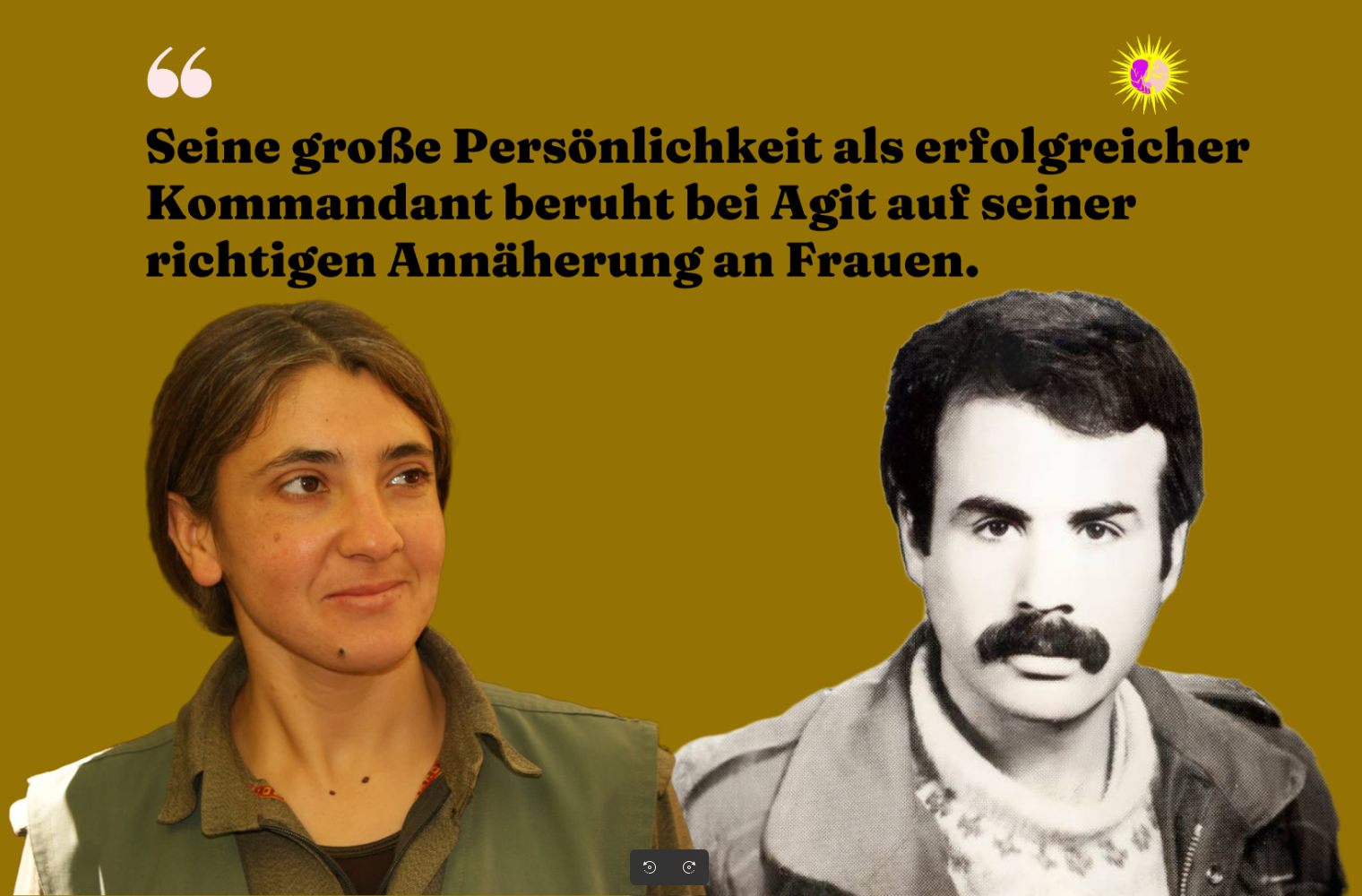
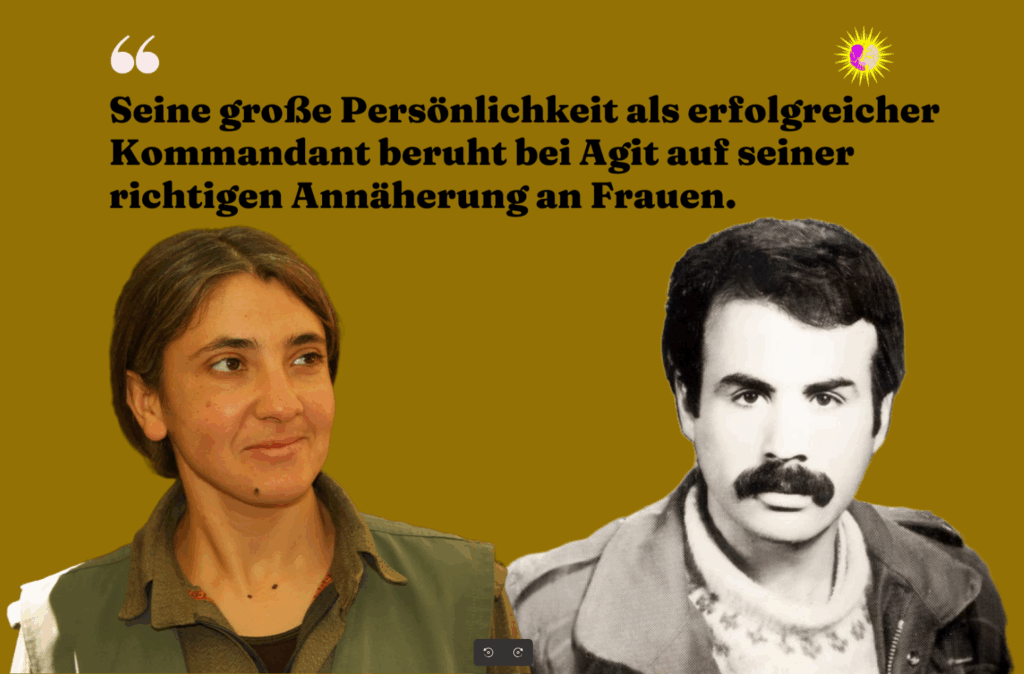
    Hierbei können auch viele Freunde aus der Geschichte unserer Partei als Beispiel aufgegriffen werden. Vor allem die Herangehensweise von Heval Agit (Mahsum Korkmaz) an Frauen ist ein Beispiel. Seine große Persönlichkeit als erfolgreicher Kommandant beruht bei Agit auf seiner richtigen Annäherung an Frauen. Die Praxis von Heval Agit in Botan (Region in Nordkurdistan), seine Beziehung zu und seine Zusammenarbeit mit den Freundinnen in seiner Einheit, hat viele Realitäten hervorgebracht. Es ist richtig, Heval Agit auf diese Weise hervorzuheben. Wenn wir in unserem gegenwärtigen Widerstand davon sprechen, wie erstickend die klassischen Ansätze der Kommandantur sind, dann hängt das damit zusammen, dass die klassischen männlichen Maßstäbe nicht überwunden werden konnten. Nur die männliche Persönlichkeit, die für die Überwindung der klassischen Maßstäbe kämpft und Respekt vor der Lebens- und Kampfeskraft der Frauen hat, kann im Krieg eine Linie des Erfolgs gewährleisten.

    Dass Heval Agit von Abdullah Öcalan als «Agitê Şêrîn» (Süßer Agit) bezeichnet wurde und ihm in Liedern so gedacht wird, hängt damit zusammen, dass er sich von klassischen männlichen Maßstäben entfernt und sich verändert hatte. Aus diesen Gründen denke ich, dass es sehr wichtig ist, die Persönlichkeit und Praxis von Agit in den Vorträgen zur Frauengeschichte zu thematisieren und sie zu recherchieren. Auch die Weisheit und Schlauheit von Heval Mazlum (Mazlum Doğan) ist ein Beispiel. Er hat sich der Frau bewusst, mit Wissen, Schönheit und Moral angenähert. Heval Mazlum war es, der Heval Agit mit der Partei in Kontakt gebracht hatte. Der gefallene Freund Şehîd Sari Ibrahim, der in der Einheit von Agit kämpfte, hatte ebenfalls eine bescheidene Persönlichkeit. Er sprach täglich über den Beginn der Praxis der Berge der damaligen Zeit und widmete der Freundinnen in dieser Zeit einen wichtigen Platz. Er sollte als eine gerechte und tapfere Männerpersönlichkeit erwähnt werden, welche die Arbeit und Mühen der Frauen respektierte.

    Es gibt viele männliche Freunde, die als Beispiele in der Frauengeschichte behandelt werden können. Wenn die Verbundenheit zur Frauenfreiheitslinie als grundlegender ideologischer Maßstab für die Männer erklärt wird, entsteht eine positive Grundlage. An dieser Stelle hat Heval Fikri Baygeldi als beispielloses Beispiel für seine Verbindung zur Ideologie der Frauenbefreiung sein Engagement für die Freiheit der Frauen an der Front der Männer zum Ausdruck gebracht. Sein Engagement für die Führungsrolle der Frauen in den Lektionen für die Freunde zu betonen wird diese positiven Grundlagen verbessern. Dadurch werden sie zu historischen Figuren.

    Auch die gemeinsame Leitungspraxis von Şehîd Besê und Şehîd Zeynel (Celal Barak) in Dersim 1994 ist ein Beispiel. Hier wurde der Geschlechterkampf auf ideologische Weise geführt und Heval Besê konnte bei Heval Zeynel wichtige Veränderungen bewirken. Wie ein richtiger Geschlechterkampf das Kampfpotenzial in einer Region steigern kann, lässt sich in der Persönlichkeit von Heval Besê erkennen. Es ist wichtig, Heval Besê im Unterricht für die Freunde als eine Frauenpersönlichkeit zu thematisieren, die die Freunde Zeynel und Ayhan transformierte. Die Größe des Freundes Zeynel zeigt sich hingegen in seinem Respekt für die Kommandantin Besê Anuş, die das Leben und den Krieg anführte. Es gibt viele solcher Beispiele. Wichtig ist es, dieses Erbe sichtbar zu machen.

    Kurz gesagt, wenn wir also Vorträge zur Geschichte der Frauen halten, müssen wir die Transformation des Mannes mehr in den Vordergrund rücken und die gesellschaftliche Ebene betonen. Die Fortschritte in der Persönlichkeit des Mannes müssen noch besser enthüllt und bewertet werden. Denn das ist der Erfolg des Widerstandes der freien Frauen. Wenn wir doch nur den gemeinsamen Kampf von Agit, Hawa, Ayşe und Azîme während des Krieges in Botan [in den 1980er Jahren] oder die Praxis von Besê und Zeynel in Dersim [in den 1990er Jahren] in einem Roman verschriftlichen könnten…

    Ein weiterer wichtiger Punkt ist es, das Erbe der Frauenrealität in der Gesellschaft Kurdistans in der Vergangenheit und Gegenwart zu thematisieren. Es liegen uns wichtige Fakten vor, die mit grosser Sorgfalt die Hinterlassenschaften der neolithischen Kultur darlegen können. Es ist ein Aufgabenbereich der Jineolojî, die Welt und unsere gesellschaftliche Realität auf diese Weise zu betrachten und kontinuierlich die Welt der Frau, ihre soziale Rolle und Mentalität sichtbar zu machen. Diesbezüglich müssen die Realitäten der Regionen, Stämme, Konfessionen, Glaubensrichtungen, in den Bergen und Städten verglichen und die Mutterkultur sichtbar gemacht werden. Wenn wir Persönlichkeitsanalysen machen, führt es zu größeren Erfolgen für die Persönlichkeits- und Bewusstseinsentwicklung, wenn die Frauen- und Männerrealität der jeweiligen Gesellschaftsstruktur mit einbezogen wird. Ausserdem ist es wichtig, die Realitäten des Mannes als Jäger, Händler und Liebhaber miteinander in Bezug zu setzen und zu interpretieren. Es ist wichtig, Vergewaltigungskultur und Faschismus als eine Realität der Männerherrschaftsmentalität zu definieren. In den letzten Jahren habe ich mich zudem mit der Realität der freien Frau in den Bergen, mit der Kämpferin und ihrer Geschichte, auseinandergesetzt und meine Gedanken vertieft. Hierbei habe ich einige wichtige Erkenntnisse gemacht. Ich habe gesehen, dass mutige, kämpfende Frauen nicht nur in Kurdistan, sondern überall, wo es starke neolithische Kultureinflüsse gab, präsent waren. Von Anatolien, der arabischen Welt bis nach Europa, wurde diese Epoche stark gelebt.

    Es war wichtig, die anatolische Mythologie von Artemis und Apollo zu sehen. Sie waren als Göttinnen-Götter der Verteidigung für ihre Pfeile bekannt. Artemis steht in Kontinuität der hurritischen Kultur und ist als Beschützerin der jungen Frauen und Bogenschützengöttin bekannt. Dass die Pfeile von Artemis aus Gold waren, zeigt, dass sie die neolithische Kultur repräsentiert und verteidigt. Sie und Apollon sind Zwillinge. Artemis hat bei mir das grösste Interesse geweckt. Apollos Pfeile sind silberfarben. Bekanntlich wurden Kupfer, Silber und Gold in der Technik und Technologie des Neolithikums verwendet.

    Auf der anderen Seite werden der Kriegsgott Ares und die Göttin Athena, die als Göttin von Athen bekannt ist und von Zeus erschaffen wurde, in der griechischen Mythologie durch Bronze- und Eisenpfeile symbolisiert. Mit anderen Worten, sie verteidigen die Zivilisationskultur und repräsentieren Krieg, Zerstörung und Plünderung. Diese Mythologien veranschaulichen die Unterscheidung zwischen der Kultur des Kampfes als Tapferkeit und Hingabe, sowie jener des Krieges für Zerstörung und Plünderung.

    Andererseits sind die Amazonenkämpferinnen mit Artemis verbunden. Es gibt sogar Erzählungen, die besagen, dass sie Artemis angebetet haben.

    Im Anatolien des 13. Jahrhunderts gab es unter der Bezeichnung „Bacılar“ (Schwestern) eine Frauenorganisierung, die neben ökonomischen Aktivitäten auch als Kämpferinnen ihre Städte verteidigten. Gegen die brutalen Angriffe der Mongolen haben sie die Städte verteidigt. Die Amazonen und kämpfenden Schwestern werden als gute Reiterinnen und geschickt mit Pfeil und Bogen umgehende Kämpferinnen bewertet. In Anatolien sind die Bacılar-Schwestern als turkmenische Frauen bekannt. Auch in der arabischen Welt wird über Frauen geschrieben, die als gute Pferde- und Kamelreiterinnen in Kriegen kämpften. In der islamischen Zeit setzte sich diese Kultur unter den Frauen fort, die der Tradition von Ahl al-Bayt angehörten. Frauen nahmen als Kriegerinnen am Krieg gegen die Tyrannei von Muawiya teil. Fatma, Ayşe und Zeynep sind einige dieser Frauen.

  • Şehîd Hêlîn Murat writes about Commander Agit, as a revolutionary personality

    Şehîd Hêlîn Murat writes about Commander Agit, as a revolutionary personality

    This is an extract from a letter that the woman guerilla Şehîd Hêlîn Murat addressed to Jineolojî from the mountains of Kurdistan. In this part, she analyzes revolutionary personalities of men and women inside of the PKK and in history. On August 15, 1984, Commander Agit led the first action of armed struggle of the PKK. The reason for his success and vanguardship can be better understood when we understand his personality and his approach towards women.

    Revolutionary men and women personalities

    When we speak of the history of woman, we must also deal with it and let it be felt in the approach and method that it is the history of the re-creation of man. In the history of our party, the emergence of the free woman is also the beginning of the emergence of the free man.

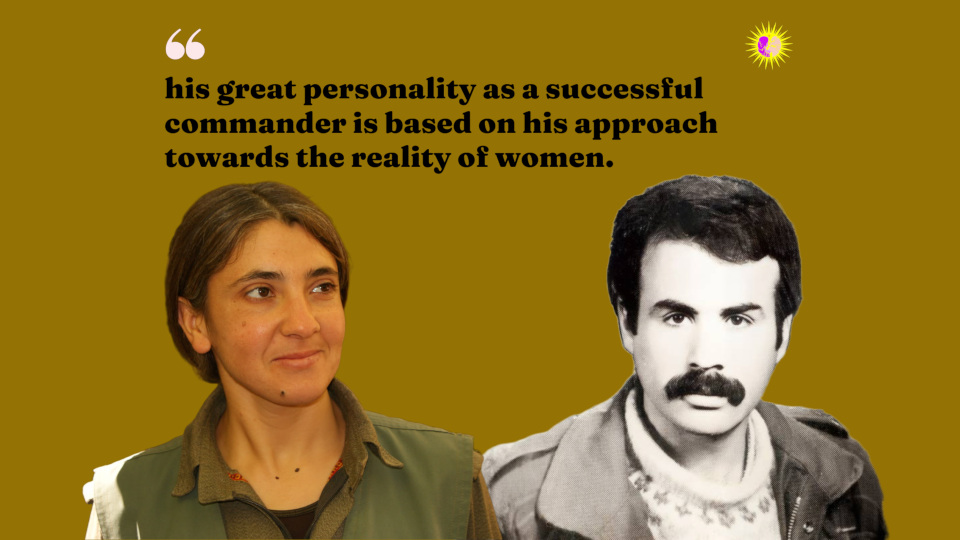
    Many friends from the history of our Party can also be taken up here. Especially the approach of Heval Agit (Mahsum Korkmaz) towards women is an example. In Heval Agit’s case, his great personality as a successful commander is based on his approach towards the reality of women. Heval Agit’s practice in Botan (region in Northern Kurdistan), his relationship with and cooperation with women friends in his unit, has produced many realities. It is right to highlight Heval Agit in this way. In our present resistance, when we talk about how suffocating the classical approaches of command are, this is related to the fact that the classical masculine standards could not be overcome. Only the masculine personality that fights to overcome the classical standards and has respect for women’s power to live and fight can ensure a line of success in war. The fact that Heval Agit was called “Egîdê Şêrîn” (Sweet Agit) by Abdullah Öcalan and that he is commemorated in this way in songs is related to the fact that he had moved away from classical male standards. In the educations on women’s history, I think it is very important to address and to research more about Agit’s personality and practice.

    The wisdom of Heval Mazlum (Mazlum Doğan) is also an example. He approached women consciously, with knowledge, beauty and morality. It was Heval Mazlum who had brought Heval Agit into contact with the movement. The fallen friend Şehîd Baranê Zer, who fought in Agit’s unit, also had a modest personality. In his memoirs, he gave space to the first experiences of women fighters. He should be mentioned as a just and brave male personality who respected the work and toil of women. When the attachment to the women’s freedom line is understood as the basic ideological benchmark for men, a positive foundation is created. For this, Heval Fikri Baygeldi is a historical figure who should always be emphasised in the educations for the friends. For, as a man, he exemplarily was connected to the ideology of women’s liberation and was associated with the vanguard of women. This is why these personalities are historical. The joint leadership practice of Şehîd Besê and Şehîd Zeynel (Celal Barak) in Dersim in 1994 is also an example. In these cases the gender struggle was conducted in an ideological way and the friend Besê was able to bring about important changes in the friend Zeynel. How a real gender struggle can increase the struggle potential in a region can be seen in Besê’s personality. It is important to address Besê as a female personality who transformed the friends Zeynel and Ayhan. The greatness of the friend Zeynel, on the other hand, is shown in his respect for the commander Besê, who played a leading role in life and war. There are many such examples. It is important to make this heritage visible. So when we give education on women’s liberation, we have to focus on the transformation of men. Because that is the success of the resistance of the free women. If only we could write down in a novel the joint struggle of Agit, Hawa, Ayşe and Azîme during the war in Botan [in the 1980s] or the practice of Besê and Zeynel in Dersim [in the 1990s].…

    Another important point is to address the legacy of women’s reality in the society of Kurdistan in the past and present. We have important facts that can present the legacy of the Neolithic culture with great care. It is a task of the Jineolojî to look at the world and our social reality in this way and to continuously make visible the world of women, their social role and mentality. In this regard, the realities of the tribes, denominations, faiths, in the mountains and cities must be compared and women’s culture made visible. When we do personality analysis, it leads to greater success for personality and consciousness development if the women’s and men’s realities of the respective social structure are included. It is also important to relate and deal with the realities of men as hunters, traders and lovers. It is important to define rape culture and fascism as a reality of the male domination mentality. In recent years, I have also been exploring the reality of the free woman in the mountains, the woman fighter and her history. In doing so, I have made some important realizations. I have seen that brave, fighting women were present not only in Kurdistan, but everywhere where there were strong Neolithic cultural influences. From Anatolia and the Arab world to Europe, this era was strongly lived. It was important to see that in the mythology of Anatolia, Artemis was as well known as Apollo as the goddess of defense with her bow and arrow. Artemis is in continuity with Hurrian culture and is known as the protector of young women and archer. The fact that Artemis’ arrows were made of gold shows that she represents and defends the Neolithic culture. She and Apollo are twins. Artemis aroused the greatest interest in me. Apollo’s arrows are also silver. As we know, copper, silver and gold were used in Neolithic engineering and technology.

    On the other hand, the god of war Ares and the goddess Athena, known as the goddess of Athens and created by Zeus, are symbolized in Greek mythology by bronze and iron arrows. In other words, they defend the civilization culture and represent war, destruction and plunder. These mythologies illustrate the distinction between the culture of battle as bravery and devotion, and that of war for destruction and plunder. On the other hand, the Amazon fighters are associated with Artemis. There are even narratives that say they were her sisters in faith. They show how widespread and important the existence of women fighters was. In the 13th century, in Anatolia, there was a women’s organization called “Bacılar” (sisters) who, in addition to economic activities, also defended their cities as fighters. They defended the cities against the brutal attacks of the Mongols. The Amazons and the fighting sisters are valued as good horsewomen and skilled fighters with bow and arrow. In Anatolia, the Bacılar sisters are known as Turkmen women. In the Arab world, women are also written about as good horse and camel riders who fought in wars. In the Islamic period, this culture continued among women who belonged to the tradition of Ahl al-Bayt. Women participated as warriors in the war against the tyranny of Muawiya. Fatma, Ayşe and Zeynep are some of these women.

  • The autonomy of women – Time to insist on our autonomous organization

    The autonomy of women – Time to insist on our autonomous organization

    First of all, we send our greetings to the fighting young women all over the world.

    We start writing this perspective by commemorating all the women that fell martyr in the vile attacks of the imperialist powers in Kurdistan, Palestine and in many other countries. From their sacrifice we take the strength and the determination to continue today the struggle for a just, human and free world.

    Our monthly perspective will deal with women’s autonomy. By autonomy, we mean the creation of spaces and structures just for women in all different areas of life. Why is autonomous organisation so important for women? Why must we always insist on our autonomy, and how will it lead us to our freedom? These are questions we will answer in this perspective with examples from history and from life. Here in Rojava, discussions about women’s autonomy are increasing after Syria’s Alewi and Druze women called for perspectives from the Women’s Movement of Rojava.

    In the past month, the jihadist transitional HTS government’s militias committed heavy massacres on religious minorities in Latakia, Suweida and other regions of Syria. These massacres must not be seen disconnected from the violent offensive that Israel and Turkey, leaded by United States and Britain, are committing against the peoples of the Middle East. As the terrible massacre committed against the people and the women in Palestine, so they want to do against the people of Syria and against everyone that does not fit into their imperialist plan. About the actual situation the women in Rojava are saying very clearly, „If we had not had our autonomous self-defense structures, they would have come for us, too. This is why we encourage all Syrian women to organize“. Pictures that arrived lately from Suweida show how the women started to mobilize and take action, the opportunity for them to build autonomous self-defense structure is now concrete. Because they realized that they have to be the leading force to defend their societies and end the dominant male jihadist mentality. Once again it is clear that just the freedom of woman can guarantee the freedom of a society. To reach this, autonomous organization is the first and fundamental step to take.

    The month of August means commemoration of the women of Shengal

    The month of August began with the anniversary of the Shengal massacre which was carried out on August 3, 2014. The Islamic State massacred the Ezidi community, killing more than 10,000 people. Women in particular were touched by the cruelty of ISIS. More than 7,000 women were abducted and sold in markets as sex slaves. More than 2,700 women are still missing. After the PKK guerrillas and the YPJ and YPG self-defence units came to Shengal and fought ISIS, the foundation was laid for the self-organization of the Ezidi society. The society was especially influenced by the courage and strength of the women fighters who took the lead in the fight. In order to be able to defend themselves specifically against sexist violence in the future, the Ezidis in Shengal set up autonomous women’s councils and the women’s units of Shengal (YJŞ). Today, the women’s structures not only guarantee the physical safety of Ezidi women, but they are also a place of common education and finding solutions to problems within society. The IS did indeed attempt to commit a complete femicide. With forced conversion, rape and murder, the Ezidi women’s existence as a whole was in danger. Therefore, the self-organization of women of Shengal today is the greatest defence of their existence.

    The brave women of Vietnam, what are their names?

    August marks the beginning of the August Revolution in Vietnam. On August 19, 1945 the Viet Minh took the Vietnamese capital Hanoi. This was the beginning of a relentless struggle for freedom and independence. Both in the August Revolution and later in the liberation war of South Vietnam, women played a central role. Over 1.7 million women fought in the Viet Cong. Countless other women were doing organizational work, as doctors and nurses, and espionage work for the revolution. The courageous Vietnamese women followed the example of the Trung sisters, who led uprisings against the Chinese invasion in 40-43 BC. In addition, Vietnamese women felt a strong attachment to their country and wanted to liberate it at any cost. But who were the Vietnamese fighters and pioneers? Why do we hardly know their names today? The first female commander Nguyễn Thị Định is a founding member of the NLF (National Liberation Front) and later led thousands of young women to the liberation of her country under the name Long Haired Army. Certainly, countless legends and novels could be written about these Vietnamese heroines, but their stories have mostly gone unheard and unwritten. This is based on the reality that although women were involved everywhere with great passion and strength, they did not organize themselves strongly enough ideologically and autonomously. They fought with determination, formed their units, but all with the goal of national liberation. Although there were some protests and demands for freedom for them as a women, they did not achieve any visible results. Aside from some legal reforms, could the Vietnam war be an answer for the women’s struggle?

    You exist as much as you are organized”

    Rêber APO says “You exist as much as you are organized “. This is especially true for us women. Without organization, our very existence is in danger. The example of Shengal makes this quite clear. And in the example of Vietnam, we also see that organizing cannot only mean participation in the general political struggle, but it must be a women’s struggle, with the liberation of woman at its centre. Otherwise the issue of women’s liberation will be pushed to the sidelines again and again. What can we learn from the stories of the women before us? Even though we may now understand how central women’s liberation is, we often fall into the traps of patriarchy. The attacks of patriarchy vary from place to place. Especially in centres of capitalist modernity, like Europe, the attacks on our existence are much more abstract and difficult to understand. So in the next part of the perspective, we want to expose some of the mindsets that we carry within us unconsciously.

    Women’s freedom comes after the revolution (or women’s meeting comes after the general one)

    In many national liberation struggles, the women’s issue was dismissed as a so-called secondary contradiction. When women in revolutionary processes made demands for their freedom and autonomy, they were often not taken seriously. Perhaps a few reforms were discussed, but there was no fundamental convergence on the subject. Women fought heroically in liberation wars, but ended up back in the kitchen afterwards. And they were often discriminated against in their own structures, sometimes even abused and raped. Okay, in theory, we understand today that the concept of “woman’s liberation after the revolution” does not work. But this pattern of thought often haunts us in our political daily lives. For example, we quickly abandon our autonomous projects and organizational work to prioritize the general political topics. We think that once the general political work in the city or village goes well, we will have the capacity to think about the structures of women. But then we often encounter aggression and sexist behaviours. We see women whose opinions are not taken seriously, who do not dare to speak their mind in meetings and discussions. Women who work all the time, but whose hard work is hardly respected. If we look closely, sexism is at the root of all power mentalities. That is why fighting it, is the foundation of all other political struggles. In our political daily life we should therefore see our women’s structures as the basis of our organization and always give priority to women’s work. Following the principle that “liberating a woman from the clutches of patriarchy is a revolution in itself”, we should give great importance to each of our steps, and never let men tell us that there are more important things than autonomous work.

    Autonomy begins in the way we approach life

    Once a young woman visited an experienced Kurdish woman guerrilla fighter. She lived at that time, because circumstances did not allow it otherwise, as a woman alone with a group of male guerilla in an academy. The young woman observed the fighter and saw that she sometimes sat with the male comrades and told stories, and sometimes stayed on her own. Sometimes, she discussed and laughed with the men, but against wrong attitudes of the male comrades she gave them strong answers and drew her boundaries. She was alone as a woman, but still never made herself dependent on the attention of the men. The young woman asked: ‘How can you live alone with these men?’ The guerrilla fighter laughed and said: “I’m not alone, I have a whole army of women behind me”. What we can learn from this story is that autonomy begins in our thoughts and feelings and can be developed and strengthened with the organization. A strong organization of women builds in ourselves the courage to stand on our own feet and have a strong stance towards men wrong behaviours, even when we are physically not together with other woman comrades. Women’s autonomy is not something just physical. It is about feeling each other as woman and always feeling the strength of other women in everything we do. We can quickly get past any uncertainty, react confidently towards sexist behaviour in everyday life and give strong responses. We do not always have to wait for the next autonomous meeting or the next autonomous education to express and defend our identity as women. Even if the possibilities do not always allow it, we should always see ourselves as a united front and always stick together and trust each others.

    More important than ever, self-organization

    Dear revolutionary young women,

    Whether we are socialists, Marxists, anarchists, ecologists, democrats, class fighters, cultural defenders, we are women! What blocks us in our political work most of the time are the internal patriarchal attacks. That is why an autonomous women’s structure is never an extra job, or a double burden, but the solution to the fight against patriarchy. Of course women organization cannot stand for its own. This is why it always has to give a strong perspective to the outside. Autonomy can never be an escape from confrontation with men. That approach would alienate us from reality. Autonomous spaces are spaces of struggle. They are the places where we as women get to know ourselves and expand our strengths. In which we see women as pioneers. Places where we can find solutions to all the different social and political problems. Here in Rojava, women are building their autonomy everywhere. From women’s communes, young women’s councils, women’s cultural movements, women’s economic committees, women’s cooperatives, from women’s self-defence units to women’s universities, women’s sports associations. That is why women in all spheres of life, in all political bodies, have their own power and bring their own colour. Here they get to know themselves, build strong bonds with each other, and give each other what they need to develop strong personalities: mutual respect, love and a strong common struggle.

Young Internationalist Women